House Renovation Business Plan (2026): Startup Costs, Profit Margins & Growth Strategy
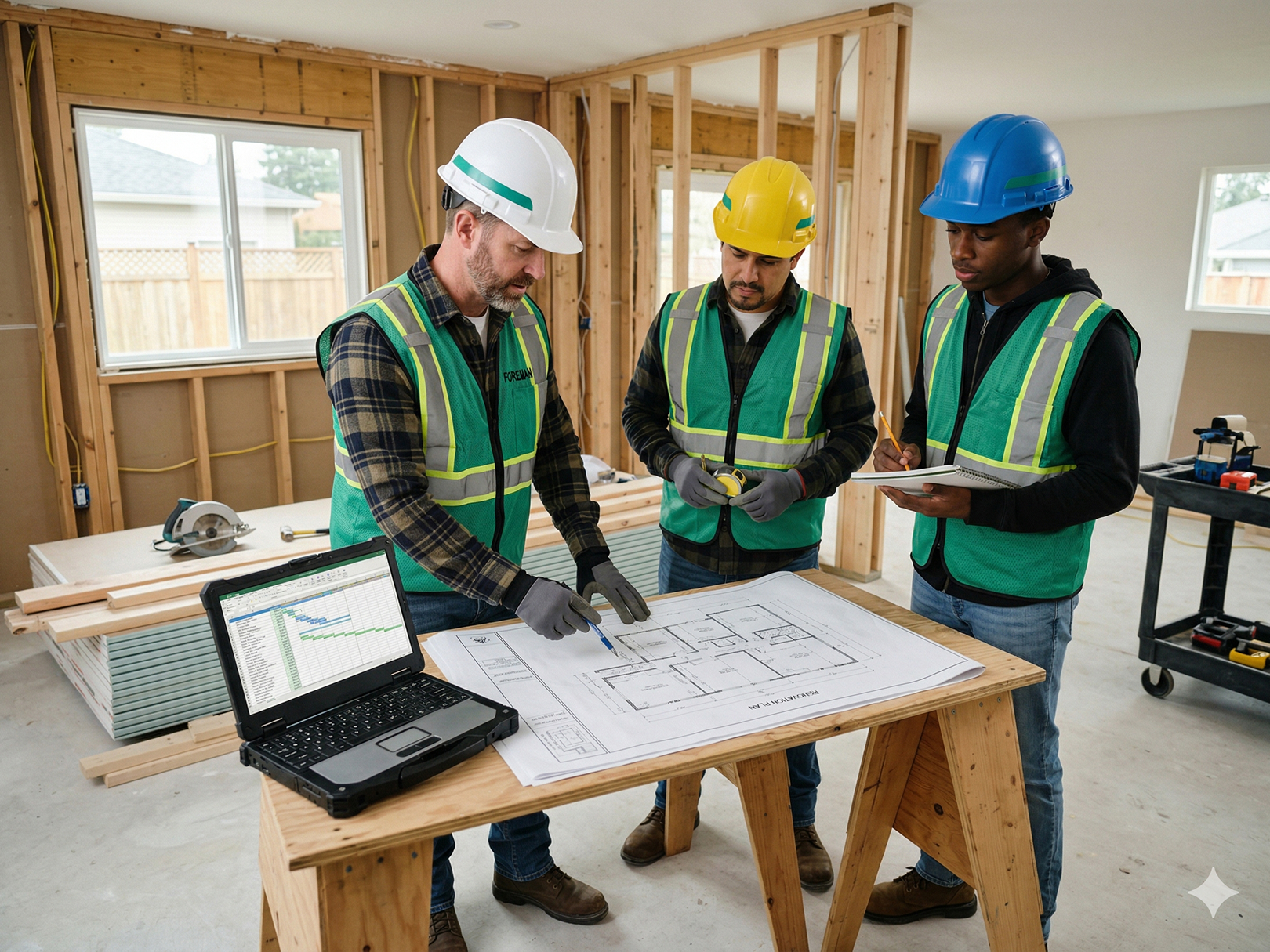
The US home renovation market projects a record $522 billion in 2026, growing +2.9% YoY (Harvard JCHS LIRA, 2026). 93% of renovating homeowners plan to hire professionals in 2026, with 55% hiring a general contractor (Houzz 2026 Renovation Plans Report).
Key Takeaways
- US renovation market: $522B in 2026, +2.9% YoY — new record high (Harvard JCHS LIRA, 2026)
- 91% of homeowners are proceeding with 2026 renovation plans (Houzz 2026 Renovation Plans Report)
- 93% plan to hire professionals; 55% will hire a GC (Houzz, 2026)
- 128,000 remodeling firms in the US — remodelers now 56% of all residential construction establishments (NAHB, 2025)
- National average renovation budget: $41,500 in 2026; Millennials average $48,500 (Block Renovation, 2026)
- Net profit margins: 4.7–8.7% industry average; best-in-class firms reach 10–12%
The Current State of the House Renovation Market in 2026
Homeowner improvement and repair spending is projected at $522–$526 billion in 2026 — a new record — driven by aging housing stock, the lock-in effect from elevated mortgage rates, and strong consumer intent (Harvard JCHS LIRA, 2026). The NAHB Remodeling Market Index (RMI) reached 64 in Q4 2025, above the 50-point break-even mark for 24 consecutive quarters (NAHB, January 2026).
NAHB separately forecasts 3% inflation-adjusted remodeling growth for full-year 2026 (NAHB, February 2026). The average US home is now 41 years old — up from 31 in 2006 — making structural renovation demand more persistent than ever.
Key Market Drivers (2026)
- Aging housing stock: Average US home is 41 years old — primary structural driver of demand
- Lock-in effect: High mortgage rates keeping homeowners in place, prompting renovation over relocation
- Energy efficiency retrofits: IRA tax credits through 2032 driving HVAC, insulation, window upgrades
- 91% of homeowners proceeding with renovation plans despite economic headwinds (Houzz, 2026)
- 56% of remodelers involved in aging-in-place work; 73% report requests increased significantly (NAHB, 2026)
How to Structure a House Renovation Business Plan (8 Sections)
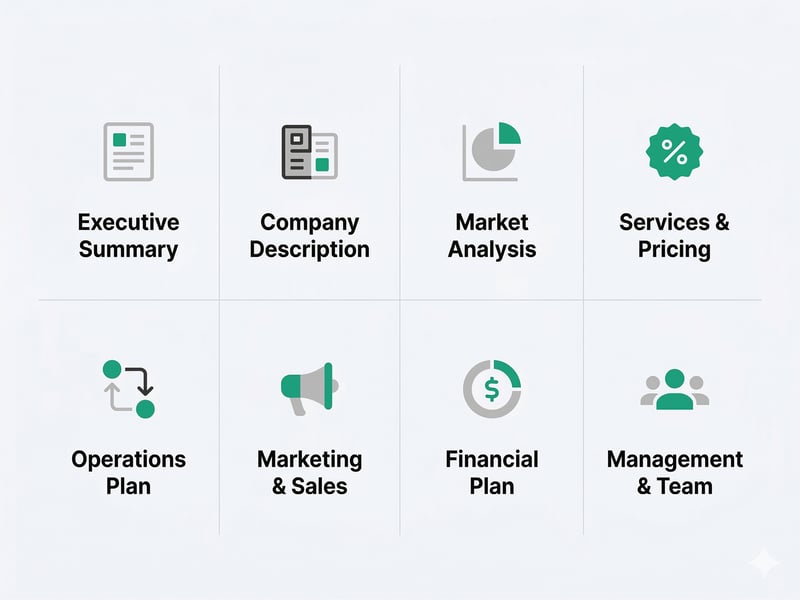
Section 1: Executive Summary
Write this last, but place it first. Cover: business concept, market opportunity, competitive advantage, financial snapshot. Keep it under 500 words. Investors decide whether to keep reading in the first paragraph.
Section 2: Company Description
Document the legal and operational foundation: legal structure (LLC, S-Corp, sole proprietor), location and service territory, founding story, licenses, certifications, and mission statement.
2026 update: New Jersey enacted mandatory GC licensing effective February 1, 2026, requiring tiered surety bonds ($10K–$50K) for home improvement contractors. Build the licensing timeline into your plan if you operate there.
Section 3: Market Analysis
Answer three questions: (1) How big is your addressable market? (Use local permits data.) (2) Who are your direct competitors? (3) Who is your ideal customer?
2026 data: National average project budget $41,500; Millennials average $48,500; 28% of Western US homeowners spend $50K+. Top 2026 project categories: bathrooms (47%), kitchens (39%), flooring (35%) (Houzz, 2026).
Section 4: Services and Pricing
Service Category | Typical Range (2026) | Target Gross Margin |
Kitchen remodel (mid-range) | $35,000–$65,000 | 25–35% |
Bathroom renovation | $17,000–$35,000 | 25–35% |
Basement finishing | $20,000–$50,000 | 20–30% |
Full home renovation | $100,000–$400,000 | 20–28% |
Handyman / small repairs | $500–$5,000 | 40–60% |
NAHB benchmark: 24.9% gross margin, 4.7% net margin (most recent NAHB Cost of Doing Business study). Updated 2026 industry estimates: 6–8.7% net for residential contractors; best-in-class: 10–12% net.
Pricing formula: Direct costs ÷ (1 − desired gross margin %) = Minimum bid. For 28% gross margin on a $30,000 job with $21,000 direct costs: $21,000 ÷ 0.72 = $29,166 minimum bid.
Section 5: Operations Plan
Document: estimating process (software used), subcontractor management (which trades you sub vs. self-perform), project scheduling (max concurrent jobs), quality control checkpoints, and software stack.
Section 6: Marketing and Sales Strategy
With 128,000 remodeling firms competing, getting found requires a deliberate channel strategy. Document lead generation channels with budget allocation and a sales process (consultation-to-contract flow).
Lead Channel | Cost Per Lead (2026) | Conversion Rate |
Referral (organic) | ~$20–30/lead | High (3–5x cold leads) |
Google Local Services Ads | $20–85/lead | Medium-high |
Facebook / Meta Ads | $30–60/lead | Medium |
Google Ads (search) | $150–400/lead | Low (2.61% avg CVR) |
SEO / Content Marketing | <$30/lead (long-term) | Medium |
Marketing budget benchmark: 2.8–3.2% of annual revenue for residential builders. Construction & Contractors Google Ads benchmark CPL: $165.67 (highest in home services) (LocaliQ, 2025).
Section 7: Financial Plan
Four components: startup cost estimate, revenue projections (Year 1–3), cash flow projection, and break-even analysis.
Startup Cost Estimate
Business Scale | Estimated Startup Cost |
Lean solo operator | $10,000–$15,000 |
Part-time professional (with helper) | $50,000–$75,000 |
Full-scale operation with crew | $250,000–$500,000 |
Note: Materials costs rose 5–7% YoY in 2026. NJ contractors now need bonding up to $50K (Feb 2026). Factor these into your startup budget.
Year 1 Revenue Projections (Solo Operator)
Scenario | Jobs | Avg Job Size | Year 1 Revenue |
Conservative | 8–10 | $15,000 | $120,000–$150,000 |
Moderate | 12–15 | $20,000 | $240,000–$300,000 |
Optimistic | 15–20 | $25,000 | $375,000–$500,000 |
Break-Even Analysis (Example Solo Operator)
Fixed Monthly Cost | Amount |
Insurance | $300 |
Vehicle payment + fuel | $800 |
Software subscriptions | $150 |
Phone + admin | $200 |
Marketing | $500 |
Total Monthly Fixed Overhead | $1,950 |
At 25% net margin → need $7,800/month in revenue to break even. That's roughly one $8,000 bathroom renovation per month.
Section 8: Management and Team Structure
Year 1 (Solo): Handle estimating, project management, and hands-on work. Subcontract specialized trades.
Year 2: Add a W-2 laborer. Frees you for higher-value tasks. Labor costs rose 4% YoY in 2026 — build this into your staffing budget.
Year 3: Add a project manager at $1M+ revenue. Document hiring criteria, compensation benchmarks, and the specific revenue trigger that justifies each hire.
Biggest Risks to Plan For
Approximately 49% of small businesses fail within 5 years (BLS, 2024). Construction 3-year survival rate: ~68%. Plan for these risks:
Risk | Likelihood | Mitigation |
Cash flow shortage | High | 3-month reserve, milestone billing, early payment discounts |
Key-person dependency | High | Document processes; cross-train; carry disability insurance |
Catastrophic project loss | Medium | Project exposure limit (max 30% of annual revenue per job) |
Licensing/compliance violation | Medium | Annual compliance calendar; monitor state changes (e.g., NJ Feb 2026) |
Subcontractor failure | Medium | Backup subs for every trade; written sub agreements |
Economic downturn | Low-Medium | Diversify service mix; maintain low fixed overhead |
How to Choose a Niche
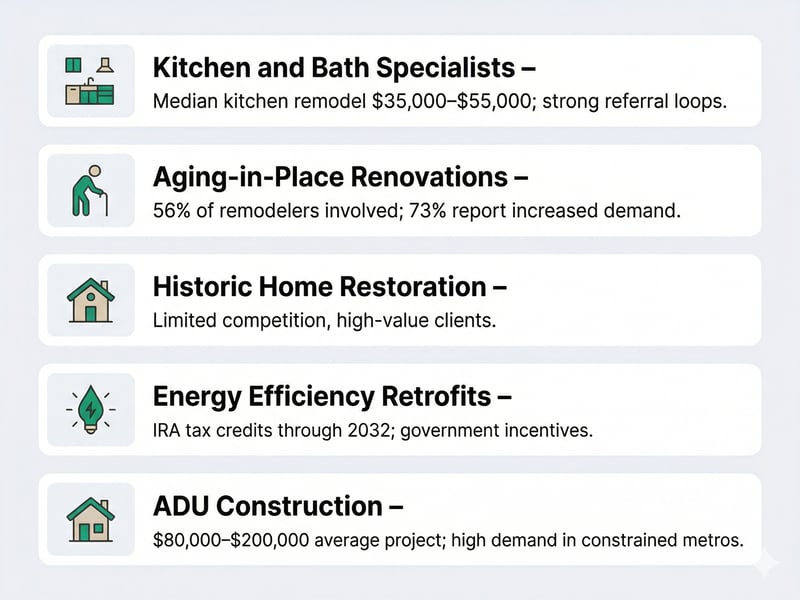
With 128,000 remodeling establishments in the US, generalists compete on price. Specialists compete on expertise. Strong 2026 niche options:
- Kitchen and bath specialists: Median kitchen remodel $35,000–$55,000; strong referral loops
- Aging-in-place renovations: 56% of remodelers involved; 73% report requests increased significantly (NAHB, 2026)
- Historic home restoration: Limited competition, high-value clients
- Energy efficiency retrofits: IRA tax credits through 2032; government incentive programs
- ADU construction: $80,000–$200,000 average project; surging demand in supply-constrained metros
Relevant Article:Home Remodeling Business Plan: A Practical 2026 Guide + Free Template Outline
Frequently Asked Questions
How much startup capital do I need in 2026?
Lean solo operators: $10,000–$15,000 with existing tools/vehicle. Part-time professional setup: $50,000–$75,000. Materials costs rose 5–7% YoY in 2026 — factor this into your startup budget.
What profit margins should I target?
Target minimum 25% gross margin. Industry average: 24.9% gross, 4.7% net (NAHB benchmark). Updated 2026 range: 6–8.7% net average; best-in-class: 10–12% net.
Do I need a contractor's license in 2026?
Licensing requirements vary by state. Most require GC license for projects over $500–$2,500. New Jersey added mandatory GC licensing effective February 1, 2026 with tiered bonding ($10K–$50K). Check your state board before writing your plan.
Sources
- Harvard Joint Center for Housing Studies (JCHS), LIRA 2026
- National Association of Home Builders (NAHB), Remodeling Market Index Q4 2025
- NAHB, Remodeling Growth Forecast, February 2026
- NAHB Eye on Housing, November 2025; March 2023
- Houzz, 2026 Renovation Plans Report
- Block Renovation, How America Renovates 2026
- U.S. Bureau of Labor Statistics (BLS), Business Employment Dynamics 2024
- LocaliQ, Home Services Search Ad Benchmarks 2025


Comments
Post a Comment